Are AI agents about to take over?
“AI agents” are the latest buzzword in a world that is becoming increasingly fascinated by the possibilities of artificial intelligence. But what do they actually mean for businesses and consumers? This question was at the centre of a panel discussion during the final JU LIVE event of the semester.
"The field of AI is developing rapidly in society, and it is important for us to share our knowledge and insights with others, including the local community, said Adele Berndt," Associate Professor of Business Administration at Jönköping International Business School and one of the researchers taking part in the discussion.
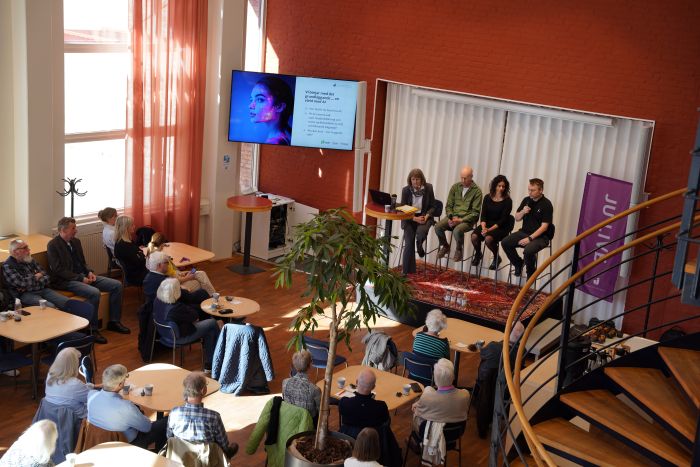
On Thursday, 23 April, researchers from Jönköping International Business School and the School of Engineering met for a panel discussion on the opportunities and risks associated with AI agents. Around fifty engaged visitors had gathered to listen, and the discussion opened with an introduction to what AI is, how the technology is evolving and what is meant by AI agents and agent‑based AI.
The audience learned that AI agents are already being used in practice. In recruitment, for example, they can analyse large volumes of applications, review CVs and, in some cases, even conduct interviews.
"AI and AI agents are shaping our modern world, including working life, how organizations operate, and how consumers think about and respond to these agents," said Adele Berndt.
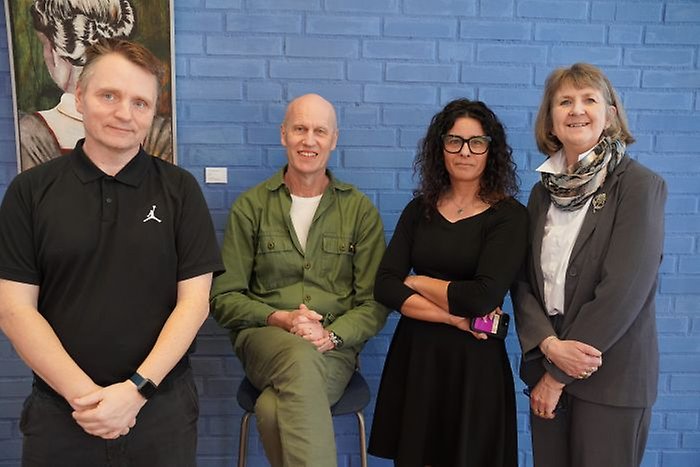
The panel featured Adele Berndt, Associate Professor of Business Administration, and Tomas Müllern, Professor of Business Administration, both from Jönköping International Business School, as well as Ulf Johansson, Professor of Computer Science, and Einav Peretz Andersson, Lecturer AI transformation, both from the School of Engineering.
AI agents are taking over large parts of the customer journey
During JU LIVE, the researchers also discussed the use of AI agents in digital commerce, where such agents can take over large parts of the customer journey – from information search to purchase and returns. This may simplify things for consumers and enable new business models, but it also raises questions about privacy, control and human autonomy.
Agentic AI refers to AI systems that do not merely respond to instructions, but can take their own initiatives, make decisions and act independently to achieve a goal.
Towards the end of the panel discussion, the audience had the opportunity to ask questions, and it was clear that the topic sparked strong engagement. Many questions focused on the risks of agentic AI, such as incorrect decisions, lack of transparency and potential infringements on personal privacy. At the same time, the importance of clear regulations, ethics and human values was emphasized.
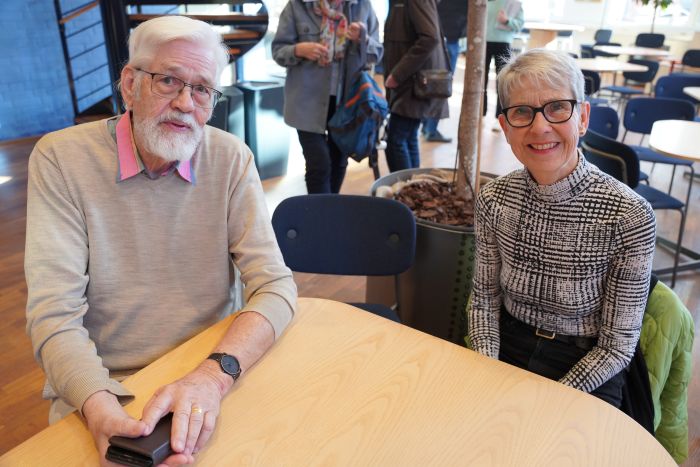
Sture Björkander and Liselotte Dahlkild.
"It feels both exciting and a bit frightening to see how fast this development has been. You really start to wonder where we are heading, said Liselotte Dahlkild," a pensioner from Jönköping.
Seated next to her was Sture Björkander, also a pensioner from Jönköping, who added:
"We feel a responsibility to make use of these systems – resisting them isn’t really an option, because society is constantly changing. At the same time, we don’t want human contact to disappear and society to become inhumane. I feel curious, but also cautious."
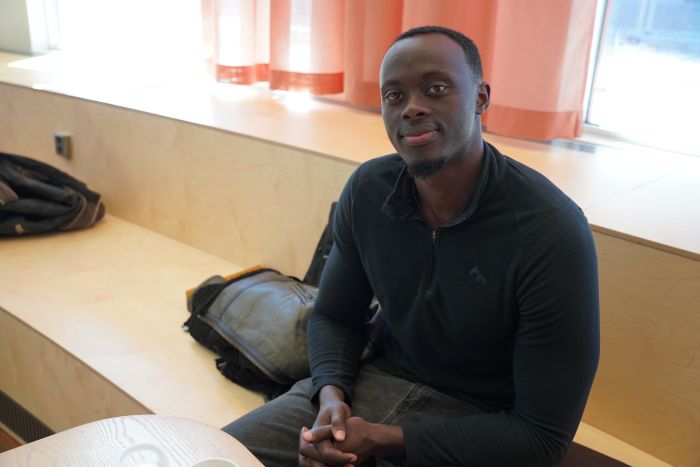
“I don’t believe that AI agents will take over in the future. Instead, I think they will help us humans develop in different areas,” said Eliezer Nivorukundo, who is studying Computer Engineering at the School of Engineering.
So, are AI agents about to take over? According to the researchers, the future is less about a world without humans and more about how humans and AI can interact in a responsible way.
JU LIVE continues
JU LIVE aims to share Jönköping University’s research with the public in an accessible and easy‑to‑understand way. Each semester features four lectures – one from each school – providing a broad range of topics.
During the spring semester, the audience heard Joakim Netz, Senior Lecturer at the School of Engineering, speak on “Sustainable preparedness – an educational issue for our time of destiny”, and Radu Dinu, Associate Professor of History at the School of Education and Communication, who explored whether comics are merely entertainment or can also convey deeper knowledge, and how they can be used in teaching.
In the second‑to‑last lecture, “Surviving the war is only the beginning – amputation and the road back to life in Ukraine”, Nerrolyn Ramstrand, Professor of Orthopaedic Technology, spoke about life after amputation and how Swedish and Ukrainian colleagues are working together to build sustainable rehabilitation and prosthetic care in Ukraine.
JU LIVE will return in the autumn with four new lectures.
More photos from the afternoon: