
CIRCUMET
Advanced School on Circular Metal Components for the Swedish Manufacturing Industry
CIRCUMET aims at creating a comprehensive joint effort for developing 80-90 credits courses in advanced level on the topic of climate action in the metal component manufacturing industry. Flexible pedagogical methods and tailored admission routines will be developed for attracting professionals from the industry.
Frequently Asked Questions about applying to the CIRCUMET Courses
Do all CIRCUMET courses have the same entry requirements?
No, the entry requirements may vary, so always refer to the specific course information on the website.
If I have extensive professional experience in the course area, can I apply even if I haven’t previously studied at university level or in the relevant field?
- For courses offered by JU and HV, you may be eligible for CIRCUMET courses if you have at least four years of relevant work experience, which will be assessed based on a submitted employment certificate. Use the certificate template available down below.
- For courses at Chalmers, an academic degree is required for eligibility. However, you can apply through a process called validation of prior learning. In this case, a combined assessment of your professional experience and previous education will determine whether you are likely to succeed in the course. Contact Chalmers for more information.
Do I need to attach any other documents when I submit my application?
- It depends. If you studied at a Swedish university before 1995 or hold a foreign degree, you will need to upload your certificates on antagning.se, unless you’ve done so previously.
- To prove your English proficiency, it may also be necessary to upload your upper secondary school certificate if it was issued before 2005. You may also demonstrate your English skills via an employment certificate that shows you’ve used English professionally.
- If work experience is required as part of the entry criteria, you must verify this with an employment certificate. See the template down below.
Who can I contact if I have questions about the application process or validation for CIRCUMET courses?
- Jönköping University:
lifelonglearning@ju.se or lina.acosta@ju.se - Chalmers University of Technology:
christer.marklund@chalmers.se - University West:
antagning@hv.se
Courses offered by Chalmers University of Technology:
- Joining for Disassembly
- Cast Component Design for Rcyclability
- Weld Design for Sustainability
- Metallic Material Development for Circularity and Future Trends – Ferrous Alloys
- Metallic Material Development for Circularity and Future Trends – Non-Ferrous Alloys
- Metallic Material Development for Circularity and Future Trends – Sustainability Aspects
Courses offered by University West:
- Industry 4.0 - Emerging Technologies
- Industry 5.0 - Human-centric Metal Manufacturing
- Joining Processes for a Modern and Sustainable Manufacturing Industry
Courses offered by Jönköping University:
- Circular Metal Supply Chain
- Science of Remelting – Aluminium Alloys
- Science of Remelting – Ferrous Alloys
You’ll find the employment certificate template for applications to Jönköping University and University West here docx, 47.6 kB, opens in new window.. Upload it under "Mina meriter" on antagning.se when submitting your application.
You can also find more FAQs (in Swedish) at: https://www.antagning.se/sv/vanliga-fragor-och-svar/
Courses Spring 2026
Industry 5.0 - Human-centric Metal Manufacturing, 2.5 credits, University West
Industry 5.0 - Human-centric Metal Manufacturing, 2.5 credits
Industry 4.0 (I4.0) is transforming manufacturing through digital technologies and enhanced process efficiency, impacting the entire supply chain. Implementation challenges require consideration of people, management, structure, and culture. In response, Industry 5.0 (I5.0) has emerged, emphasizing sustainable, human-centered perspectives. I5.0 complements I4.0 by integrating human skills with advanced technologies, fostering a symbiotic relationship between humans and machines, and promoting value creation and resilience.
PS. Don't miss the webinar mentioned above!
Read more and apply here! External link, opens in new window.
Courses Autumn 2026
Energy and Resource Efficient Additive Manufacturing, 2.5 credits, University West
Energy and Resource Efficient Additive Manufacturing, 2.5 credits
Discover how metal additive manufacturing is shaping the future of sustainable production.
This course introduces the fundamentals of metal additive manufacturing, combining essential theory with real‑world industrial applications. You’ll gain insight into the most common AM technologies for metals, such as powder bed fusion and Directed Energy Deposition (DED), and explore ongoing research and development in Sweden and across Europe.
Designed for working professionals in the manufacturing industry, the course highlights how metal AM can enable resource‑efficient production, material recycling, and circular economy solutions. Developed in close collaboration with industry, the course is flexible and fully compatible with full‑time work—giving you practical knowledge you can apply directly in your organisation.
Read more and apply here. External link, opens in new window.
Design and Analysis of Experiments, 2.5 credits, JTH
Design and Analysis of Experiments, 2.5 credits
Data-Driven Process Improvement through Design of Experiments
Do you want to make more confident, data-driven decisions and systematically improve manufacturing processes? This course provides practical tools to plan, conduct, and analyse experiments in real industrial environments. By working with statistical thinking and modern approaches to Design of Experiments, you will learn how to identify the factors that influence quality, performance, and variation – and how to optimise them in a structured and efficient way.
The course is designed for professionals in production, quality, process development, and R&D who want to strengthen their ability to use data as a basis for improvement. The focus is on industrial applications, particularly within metal manufacturing, where sound analysis can support more stable processes, better use of resources, and well-grounded decisions.
After completing the course, you will have a clear methodology for testing ideas, evaluating results, and driving improvement initiatives based on evidence – skills that are directly applicable in your daily work and valuable for both you and your organisation.
Foundations of Data Driven thinking, 2.5 credits, JTH
Foundations of Data Driven thinking, 2.5 credits
Unlock the value of your manufacturing data with the Foundations of Data-Driven Thinking.
This course targets a wide range of roles in industry and the public sector, such as decision-makers, engineering and technical specialists in design and production, and R&D personnel, who seek practical insight into how data-driven AI can be leveraged to create value in their organizations. Working hands-on with real industrial datasets, you’ll learn how to handle common manufacturing data types, such as sensor and time-series data, process and production logs, and quality and test measurements. You will apply methods to:
- assess data quality and readiness (noise, drift, missing values, inconsistencies)
- clean and prepare data for analysis
- perform exploratory data analysis to reveal trends, relationships, and root causes
- visualize and communicate insights in clear, decision-oriented ways.
You’ll also learn how to use the gained insights to plan the next step in an analytics or AI initiative, such as building solutions for predictive maintenance, automated quality inspection, anomaly detection, scrap and yield improvement, process monitoring, or throughput and cycle-time prediction.
Machine Learning and AI in Manufacturing, 2.5 credits, JTH
Machine Learning and AI in Manufacturing, 2.5 credits
Transform manufacturing performance with the power of AI and machine learning.
Machine Learning and AI in Manufacturing Analytics equips professionals with the tools and knowledge to harness predictive modeling, anomaly detection, and explainable AI to improve quality, reduce waste, and optimize industrial processes.
Through hands-on experience with real manufacturing data, participants gain practical expertise in modern machine learning techniques, robust validation methods, and responsible AI practices including transparency, fairness, and risk management.
This course emphasizes the deployment of interpretable, sustainable, and trustworthy AI solutions that enhance decision-making and support the transition toward more efficient, resilient, and data-driven manufacturing system.
Science of Remelting - Aluminium Alloys, 2.5 credits, JTH
Science of Remelting - Aluminium Alloys, 2.5 credits
Drive innovation in aluminium recycling and sustainability!
This course is your gateway to mastering the science behind lightweight, corrosion-resistant, and endlessly recyclable aluminium—an essential material in automotive and aerospace industries. Learn to optimize remelting processes, control impurities with precision, and enhance alloy quality, all while reducing environmental impact. With the growing demand for sustainable, high-quality recycled materials, this course equips you with the skills to lead the way in transforming aluminium production for a greener future.
Courses to be developed
- Digital Product Passports: Legal Framework, Standards, and Industrial Readiness, 2.5 credits, start Spring 2027
- From Data to Digital Product Passport: Practice and Implementation for Industry, 2.5 credits, start Spring 2027
- Design for Minimal Material Utilization, 5 credits, start Spring 2027
- Modelling and Simulation for Circular Metal Component Manufacturing, 7.5 credits, start Spring 2027
Previous courses
Science of Remelting - Ferrous Alloys, 2.5 credits, JTH
Science of Remelting - Ferrous Alloys, 2.5 credits
Advance Your Expertise in Iron and Steel Casting!
This course provides a comprehensive foundation in the theoretical and practical aspects of manufacturing iron and steel castings, focusing on the essential characteristics of iron-based alloys. Designed for professionals in metallurgy and materials engineering, the curriculum emphasizes both process understanding and quality control in casting technologies. This course bridges theoretical knowledge with practical application, equipping you with the skills to optimize processes, enhance material properties, and ensure casting excellence. Ideal for those seeking a deeper academic understanding or advancing in metallurgical fields.
Metallic Material Development for Circularity and Future Trends – Non-ferrous alloys, 2.5 credits, Chalmers
Metallic Material Development for Circularity and Future Trends – Non-ferrous alloys, 2.5 credits
Designing Alloys for a Circular Future
Can non-ferrous alloys become truly sustainable? This course explores aluminium, magnesium, titanium, and nickel-based alloys, focusing on their recycling potential and innovative design for circularity. Learn to critically evaluate sustainability challenges, assess secondary feedstock strategies, and explore cutting-edge research on alloy development. Gain the skills to shape a more resilient and resource-efficient future.
Metallic Material Development for Circularity and Future Trends – Ferrous alloys, 2.5 credits, Chalmers
Metallic Material Development for Circularity and Future Trends – Ferrous alloys, 2.5 credits
Sustainable Steel: Designing Ferrous Alloys for a Circular Future
Ferrous alloys are key to the green transition—but how can we make them truly sustainable? This course explores strategies for life-time extension, recycling, and lean composition steel design. Learn to use Thermo-Calc for predicting phase formations in recycled steels and critically assess cutting-edge solutions for circular alloy development. Gain the expertise to drive sustainable innovation in the steel industry.
Metallic Material Development for Circularity and Future Trends – Sustainability Aspects, 2.5 credits, Chalmers
Metallic Material Development for Circularity and Future Trends – Sustainability Aspects, 2.5 credits
Master Sustainable Metal Solutions for the Green Transition
Explore the critical role of metallic materials in sustainability and the circular economy. This course covers key challenges in metal production, recycling strategies, and innovative solutions like mega casting and additive manufacturing. Learn to analyze and address sustainability issues from environmental, economic, and societal perspectives. Gain the skills to critically assess metal-related sustainability challenges and propose circular strategies for a greener future.
Joining Processes for a Modern and Sustainable Manufacturing Industry, 2.5 credits, University West
Joining Processes for a Modern and Sustainable Manufacturing Industry, 2.5 credits
Material Joining for a Sustainable Future
Enhance your expertise in modern welding with a focus on sustainability, quality, and productivity. This course explores advanced arc welding processes like CMT, STT, and TIG DynamicWire, as well as multi-material joining in the automotive industry. Learn to optimize welding parameters, reduce waste, and improve efficiency through cutting-edge techniques. Engage in interactive discussions and apply your knowledge directly to real-world challenges.
Cast Component Design for Recyclability, 2.5 credits, Chalmers. Closed for application
Cast Component Design for Recyclability, 2.5 credits
Design castings for a sustainable tomorrow!
Casting is one of the most widely used manufacturing routes, but how we design cast components today will determine their recyclability and value in tomorrow’s circular economy. This course gives you the tools to make smarter material and process choices, optimize component geometry, and apply design-for-recycling principles that enhance both performance and sustainability. With case studies, industry insights, and practical design methods, you will learn how to turn recyclability into a driver of innovation and competitiveness in casting.
Closed for application.
Weld Design for Sustainability, 2.5 credits, Chalmers. Closed for application
Weld Design for Sustainability, 2.5 credits
Smarter welds, greener future?
Learn to design welded components and structures that are strong, sustainable, and efficient. This course combines weld design principles based on international standards with awareness on durability, resource efficiency, and circularity. You’ll explore welding processes, their physics, and key non-destructive testing (NDT) methods, while building the skills to assess welds and make informed design choices for quality and sustainability.
Closed for application
Industry 4.0 - Emerging Technologies, 2.5 credits, University West. Closed for application
Industry 4.0 - Emerging Technologies, 2.5 credits
Elevate your career with our Industry 4.0 course, tailored for professionals ready to lead the digital manufacturing revolution. Explore the shift from mechanization to smart systems, mastering technologies like Virtual Factory, Digital Twins, IoT, Big Data, and AI. Learn cybersecurity essentials and analyze real-world case studies to identify improvement opportunities. Combining theory and practical exercises, this course prepares you for roles in manufacturing engineering, digital transformation, and technology implementation. Enroll now to drive innovation.
Closed for application
Joining for Disassembly, 2.5 credits, Chalmers. Closed for application
Joining for Disassembly 2.5 credits
Joining Methods for Sustainable Design and Reuse
Joining isn’t just about holding things together; it’s about shaping how we design, reuse, and recycle. This course explores joining techniques that support circular design and material reuse. Focusing on non-fusion methods like adhesive bonding, mechanical joining, and brazing, you will examine how joining choices impact performance, recyclability, cost, and disassembly. The course builds a real-world approach to selecting methods based on material properties, mechanical demands, and environmental impact.
Closed for application.
Circular Metal Supply Chains, 5 credits, JTH. Closed for application
Circular Metal Supply Chains, 5 credits
From Linear to Circular: Master the Metal Supply Chain
This course explores how the transition toward a circular economy is transforming purchasing and supply functions in the metals industry. The course provides practical insights into digital product passports, life cycle analysis, and the role of purchasing in building sustainable and competitive business models. You will develop skills to compare materials and suppliers from a sustainability perspective, improve communication across organizational and supply chain boundaries, and understand how legislation, customer demands, and new production technologies influence supply chains. Designed for professionals in purchasing, logistics, or supply chain management, the course combines theory and practice in English.
What happens next?
%20Circumet%20timeline.png)
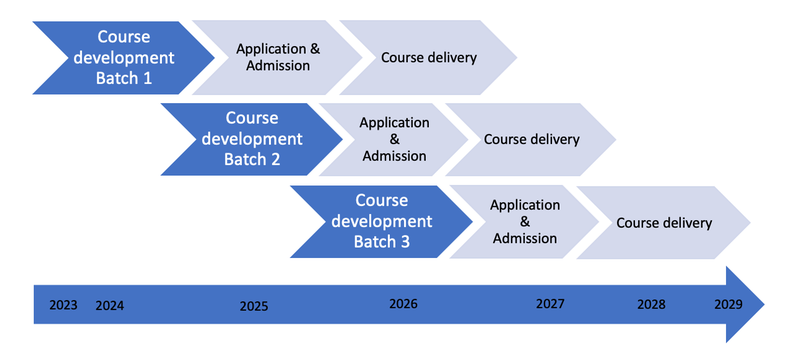
In late 2023 and during 2024 courses will be decided, and planned, and the first batch of courses will start to be developed. The first batch of courses open for application will be released in spring 2025, and those courses will start in autumn 2025. Since we are at an early stage of the project, course format, application procedures and prerequisites are not yet set.
But do sign up above to receive information as soon as such is posted.
The CIRCUMET plan
Objective
- Create a joint effort for developing 80-90 credits courses at advanced level on the topic of climate action in the metal component manufacturing industry.
- Develop flexible pedagogical methods, and innovative admission/validation routines for effective competence supply for the professionals in the industry.
- Pilot-run the developed courses and accordingly fine-tune the methodologies and contents if needed.
- Plan and develop the industrial research school proposal on the climate action for the metal industry.
Importance of the project
Particularly in Sweden, the manufacturing industry is considered the backbone of the economy, with more than 13% contribution to the GDP, and the metal component manufacturing industry is among the top sectors. Yet manufacturing sector has an outsized impact on the environment with around 20-25% direct CO2 emissions.
On the other hand, there are very limited and, in most cases, scattered educational packages related to climate action in the metal component manufacturing industry. This highlights the urgency and importance of developing tailored and flexible competence supply in both academia and industry, in order to effectively fight against climate change in the metal component manufacturing sector.
Expected results
The effort covers the circularity and sustainability in the entire value chain of metal component manufacturing; from component design optimization, to manufacturing processes, material selection, and even after the component lifetime. Important topics such as Digitalization, Life cycle analysis, and Business models in circular metal component manufacturing are embedded within the project scope.
This is in-line with many industrial sectors’ commitment to the business ambition for a 1.5˚C goal, which targets a climate-neutral and circular business by 2040. The Swedish “Riksdag” also has a clear goal in this regard: by latest 2045, Sweden must have no net emission of greenhouse gasses to subsequently achieve negative emissions.
Project team

Financier: KK-Stiftelsen External link, opens in new window.
Duration of the project: 2023-2029
Management team:
Ehsan Ghassemali, Assoc. Prof. JTH
Johan Ahlström External link, opens in new window., Prof. Chalmers
Madelene Zetterlind, Pedagogical developer, JTH
Stefan Brolin External link, opens in new window., External relations, JTH
Industrial Partners:
GKN Aerospace Sweden, Sandvik Coromant, Fagerhult, Husqvarna Group, Scania CV, Volvo Cars, Comptech, AGES Industri, Ovako, Stena Metal International, Gjuteriföreningen, Jernkontoret, Svenskt Aluminium, Tunga Fordon, Fordonskomponentgruppen
Contact us
We would be glad to hear your opinion and suggestions:
For specific questions about applications and eligibility, send a mail to: LLL@ju.se
Project leader: Ehsan Ghassemali
Deputy leader: Johan Ahlström (Chalmers) External link, opens in new window.
Pedagogcal developer: Madelene Zetterlind External link, opens in new window.
Marketing and communication: Stefan Brolin, Linda Bergqvist Opens in new window.

Text
Text
Text